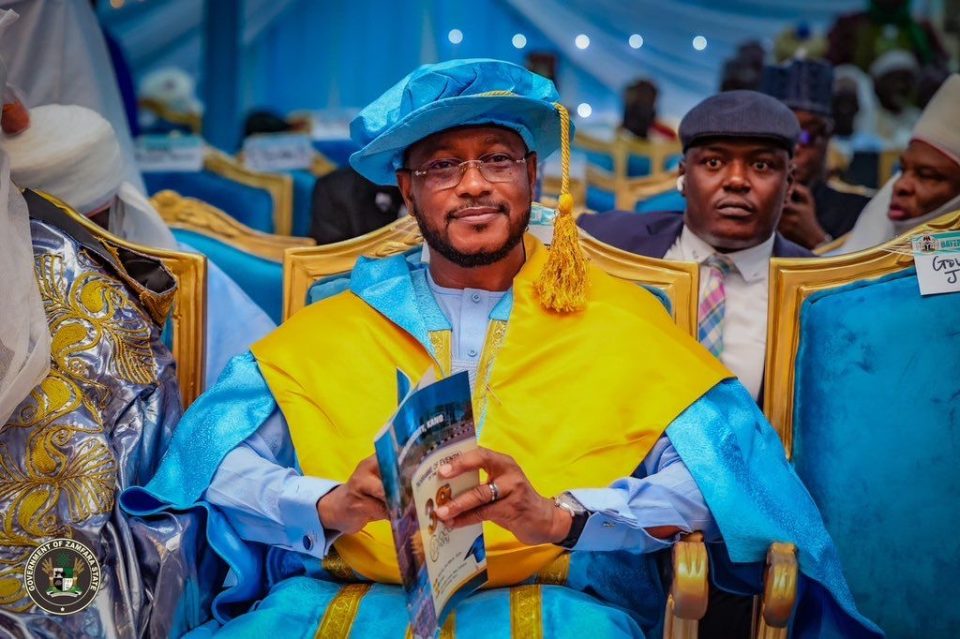
By: Bashorun Oladapo Sofowora

For those who know Zamfara State before Governor Dauda Lawal became Governor will appreciate the current situation in the state. The state, which used to be in the rubble, has been reconstructed into a powerhouse within its geographical location and has become an envy of others. All thanks to the visionary rescue mission 1.0 spearheaded by Governor Dauda Lawal, PhD, in 2023, when he was elected Governor of the agrarian and mineral-rich state.
Just three years ago, education in Zamfara State was in a Comatose state. It was nonexistent. No functional primary and secondary schools conducive to learning. The narrative was one of despair: schools as ghost towns, examination halls locked by creditors, and a generation of children seemingly abandoned by systemic neglect. But for Governor Dauda Lawal, a leader who views governance not as a relay race but as a rescue mission, the story has changed with just three years in charge of the affairs of the state.
When he assumed office, the education sector wasn’t just ailing; clinically, it was on life support. Massive debts had piled up, teachers had vanished into thin air and the number of out-of-school children was skyrocketing on a daily basis. However, two years into the “Lawal era,” the sound of silence in Zamfara’s classrooms has been replaced by the sound of flipping of new textbooks and the scratching of pens on examination answer sheets.
One of the cruellest legacies Governor Lawal inherited was the hostage crisis of student futures. Students could not write exams, classes were dilapidated and qualified teachers. Past administrations had failed to remit examination fees to the West African Examinations Council (WAEC) and the National Examinations Council (NECO). Consequently, thousands of bright Zamfaran students saw their results withheld not because they failed, but because the state failed them. Some had to travel to neighbouring towns like Sokoto, Katsina and Kano to enrol for exams risking their lives.
In a dramatic move that sent shockwaves through the opposition, Governor Lawal reached into the state’s coffers and cleared the backlog of a staggering: ₦1.4 billion to WAEC covering debts from 2018 to 2022, and a combined payment of over ₦1.34 billion to NECO covering debts from 2014 to 2021. The immediate effect was the release of all previously withheld results, allowing students to finally apply for higher education. Furthermore, the state fully funded the 2024 WAEC examinations, ensuring that no child was barred from sitting for their finals due to a lack of funds.
Governor Lawal after his swearing in, declared a State of Emergency on Education in November 2023, this meant that governance moved from the air-conditioned offices in Gusau to the muddy fields of rural schools across the state. He rolled his sleeves and got to work almost immediately fixing the rot he met. Available data from the Zamfara State Government reveals that the state has embarked on the construction and renovation of over 500 schools across all 14 Local Government Areas. This is not a cosmetic paint job, the administration is investing in modern, safe, and dignified learning environments:
Classroom Revolution: Through the UBEC-ZSUBEB Matching Grant and AGILE projects, contracts worth over ₦5.9 billion have been awarded to build schools meeting global standards.
Furniture Supply: The administration has distributed over 12,000 two-seater desks for students and over 1,000 chairs for teachers, ending the era where pupils sat on bare floors to learn.
Recruitment of more teachers and supply of more textbooks: Infrastructure without manpower is a shell. When Governor Lawal looked at the teacher-to-pupil ratio in the state, he saw a crisis. In a decisive move to reverse the brain drain, he approved the massive recruitment of 2,000 qualified teachers.
The recruitment is strategic, the first batch of 500 focuses on critical science subjects (English, Mathematics, Chemistry, Physics), preparing Zamfaran youth for the 21st-century economy. The government is also finalising a 120-day Rapid Intervention Action Plan to audit payrolls, map schools, and secure school environments from illegal encroachment.
For the 2025 fiscal year, Governor Lawal presented a “Rescue Budget 2.0” of N545 billion. The largest single allocation, N79.6 billion, representing 14% of the entire budget, went to Education. For 2026, the proposed budget allocates an additional N65 billion to sustain this momentum. However, a journey to the Renaissance is not complete. It is at this critical inflexion point that the people of Zamfara face a defining choice. Before Governor Lawal, Zamfara was a state where students were barred from exams due to unpaid debts. Today, those chains are broken completely. But the enemy of progress is not just failure; it is interruption. The gains made in education are still fragile and need continuous consolidation. The newly recruited teachers need continuous training and the 500 renovated schools need constant security and maintenance. The unified Education Sector Bill, designed to create a seamless system from early childhood to tertiary level, is still awaiting full legislative maturity.
To stop the “Rescue Mission 2.0” now would be to hand the baton back to those who drove the system into educational bankruptcy. The same political forces that allowed the debt to accumulate to over N2 billion are already regrouping eyeing 2027. They promise something different, but their records speak of withheld results and abandoned classrooms. Governor Dauda Lawal is not merely constructing classrooms; he is dismantling the architecture of ignorance that held Zamfara backwards for decades. He has proven that with political will, the “Education Governor” can turn around a sector that was declared dead.
To secure this legacy, to ensure that children never again sit on bare floors and to guarantee that WAEC and NECO never again hold Zamfaran results hostage, the mission must continue for a secured future. The vote for continuity is a vote for the future. By re-electing Governor Dauda Lawal, Zamfara will not just be learning to read and write, but also to win in all ramifications and also put the state on a winning streak.
