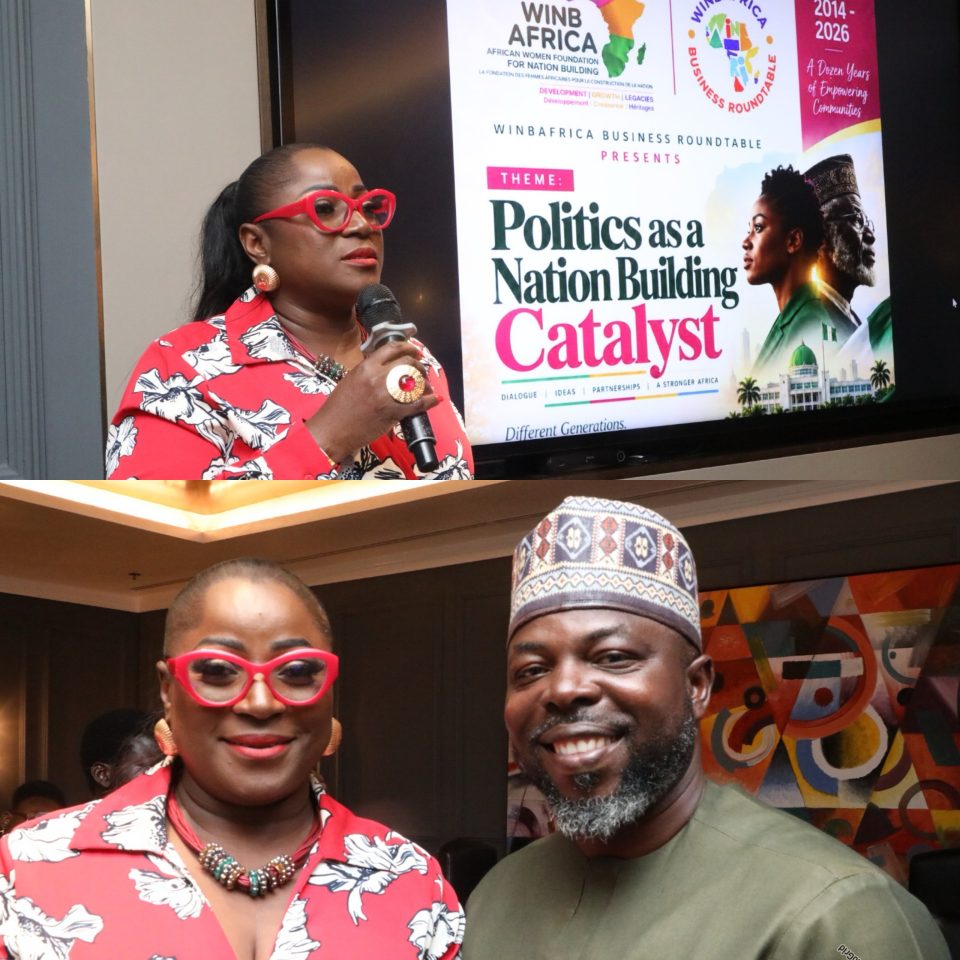
LAGOS — Rising transportation costs, inadequate infrastructure and limited economic opportunities for women and young people dominated discussions at a WIMB Africa Business Roundtable, with stakeholders calling for policies that translate government decisions into measurable improvements in citizens’ daily lives.
Stakeholders from the business, media, creative, engineering, legal, and political sectors said sustainable national development requires more than government action, stressing the need for effective institutions, policy implementation, and an informed citizenry capable of holding public officials accountable.
They spoke at the monthly Business Roundtable organised by the African Women Foundation for Nation Building (WIMB Africa) at the Marriott Hotel, Ikeja, Lagos.
The roundtable, themed “Politics as a Nation-Building Catalyst,” which provided a platform for sector-focused dialogue on pressing economic and national issues, exchange of perspectives and exploration of practical solutions, brought together WIMB Africa Founder, Dr Bukola Bello Jaiyesimi; keynote speaker, Mayor Akinpelu; moderator, Mr Gbadebo Akinyemi; former Rector of Yaba College of Technology, Engr. Obafemi Omokungbe; CEO, HONTAR; Barr. Deji Fasunwon; veteran journalist and media career development specialist, Lekan Otufodunrin; former Chairman, Odi-Olowo LCDA, Hon. Rasak Ajala; WIMB Africa Project Coordinator, Omotayo Jane; Ms. Anjolaoluwa Olanrewaju, among other stakeholders.
Speaking at the event, former Rector of Yaba College of Technology, Engr. Obafemi Omokungbe, said infrastructure investments would have limited impact without policies and institutions capable of sustaining them.
“Policy is not a mere set of government interventions. It is the underlying system that allows families, institutions, markets, communities and citizens to function effectively,” Omokungbe said.
He identified roads, electricity, water and broadband as critical infrastructure, but stressed that their effectiveness depended on the policy framework governing their development, maintenance and use.
“A weak policy environment can undermine even a well-funded physical infrastructure,” he added, calling for stronger institutions, clear standards and effective implementation.
The keynote speaker, Mayor Akinpelu, said policy reforms could promote economic stability and create a more predictable environment for businesses to plan and invest.
He, however, noted that economic reforms could affect different segments of society differently, urging policymakers to introduce targeted interventions for vulnerable groups, particularly rural women.
Akinpelu also encouraged WIMB Africa to promote cooperative societies among women, arguing that collective economic structures could improve access to resources and reduce the pressure of individual survival.
“When women form cooperative societies in different areas, they will be able to pull together resources that will help them as a group instead of trying to survive as individuals,” he said.
Veteran journalist and media career development specialist, Lekan Otufodunrin, examined the effects of major government policies on households and businesses, citing the removal of fuel subsidy as an example of a decision with wide-ranging economic consequences.
He noted that the policy had significantly affected transportation costs, with the impact extending to other areas of economic activity.
The roundtable also placed strong emphasis on citizen oversight and public accountability. Participants urged Nigerians to take greater interest in government budgets, public expenditure and projects earmarked for their communities.
They said citizens should be able to demand information about public funds allocated to specific projects, while the media and civil society organisations should provide platforms for scrutiny, public education and engagement.
The participants further examined mechanisms for holding elected officials accountable, including constitutional provisions governing legislative representatives and the role of civic participation and political engagement in demanding improved public performance.
Founder of WIMB Africa, Dr. Bukola Bello Jaiyesimi, said the roundtable reflected the organisation’s broader commitment to community empowerment and nation building across Africa.
“What we try to do is to lead, learn and leverage impact,” Jaiyesimi said.
She explained that the decision to focus the latest edition on politics was deliberate because political decisions have direct implications for governance, development and citizens’ everyday experiences.
Adding a generational perspective to the discussion, social-impact artist and climate-justice advocate, Ms. Anjolaoluwa Olanrewaju, urged young Nigerians to become better informed and more actively engaged in national affairs.
Olanrewaju said the discussion challenged her to look beyond the perception that politics was solely the responsibility of government or older generations.
“It has also prompted me to do more research and be more involved in the political affairs of the nation. So, not just leaving politics for governments, I also have a part to play,” she said.
Established in 2014, WIMB Africa operates across five African countries. Its monthly Business Roundtable brings together stakeholders from different sectors to examine pressing national issues, exchange perspectives and explore practical solutions to development challenges.
