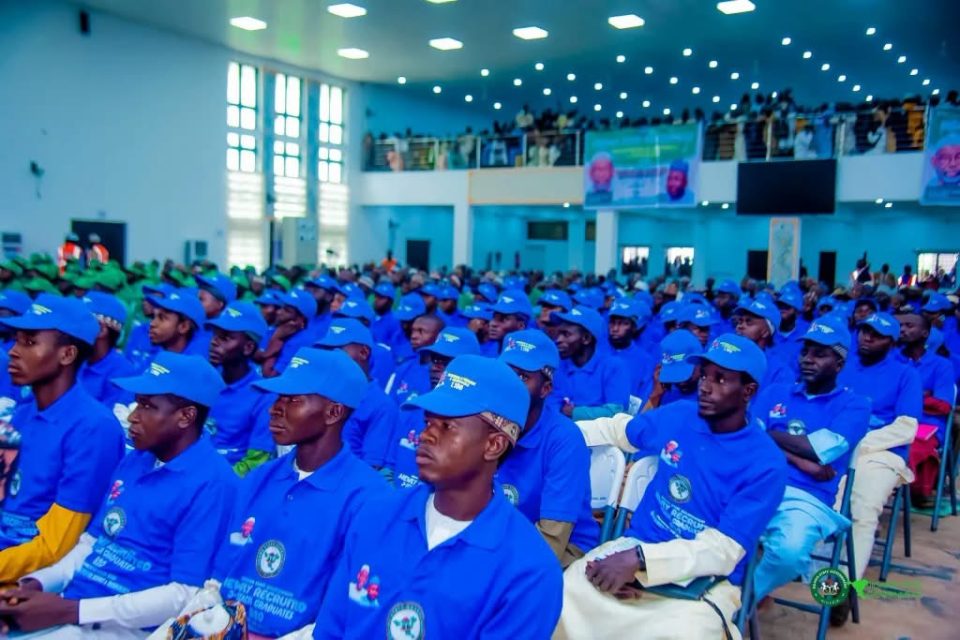
The Jigawa State Government has recruited 2,020 teachers to fill gaps in its public primary, junior and secondary schools across the state.
For many years, a shortage of teachers has been affecting teaching and learning in public schools in Jigawa, especially in rural communities where many schools have few teachers handling large classes.
The situation has forced the former administration of Muhammad Badaru and the present administration of Governor Umar Namadi to introduce a temporary teaching programme tagged J-Teach.
Under the J-Teach programme, qualified and interested teachers are employed on a temporary basis to teach in nearby public schools in their areas and, after some time, are absorbed into full-time permanent and pensionable appointments.
Speaking at the presentation of appointment letters held on Friday at the Banquet Hall, Government House, Dutse, the Jigawa State Governor, Umar Namadi, said the event demonstrated his administration’s commitment to promoting quality education.
The governor stated that the development came barely a month after the government provided school uniforms, bags and writing materials to thousands of learners across the state to improve access and strengthen learning conditions.
He said, “Today, we complement that investment by expanding the teaching workforce and directing qualified teachers to schools where shortages are most acute, particularly in underserved rural communities.”
“This occasion therefore marks another purposeful step towards better teaching, improved learning outcomes and a stronger future for every child in Jigawa State,” Namadi added.
While giving the breakdown of the recruitment, the governor disclosed that, “We are formally presenting appointment letters to 2,020 beneficiaries: 1,200 former J-TEACH personnel who have successfully completed the required training and selection process and are now being converted to permanent and pensionable status, and 820 newly recruited personnel joining the J-TEACH Programme.”
According to him, beyond strengthening the teaching workforce, the appointments would advance the government’s commitment to creating jobs and sustainable livelihoods for qualified young people.
He, therefore, announced that “the occasion also includes distribution of 450 bicycles donated by Guaranty Trust Bank to pupils and students who travel long distances to schools in hard-to-reach communities.”
He said, “By easing the burden of daily travel, these bicycles will improve access, punctuality, attendance and retention, particularly for learners whose homes are far from their schools.”
Namadi commended GTBank for the gesture under its corporate social responsibility, saying the partnership showed how the private sector could complement government efforts to ensure distance did not deny children the opportunity to learn.
He also described education as central to the vision for a greater Jigawa, noting that, “Education remains the most decisive factor in determining how individuals and communities can prosper,” adding that “People can scarcely thrive without knowledge, skills and tools that quality education provides.”
Furthermore, the governor reaffirmed that his administration continued to commit a significant proportion of the annual budget to education, adding that investments in classrooms, furniture and instructional materials must be matched by qualified teachers.
He added, “Government recognises that better learning outcomes depend above all on teacher quality; accordingly, through the Teacher Development Agency, we will give sustained attention to induction, continuous training and retraining.”
He further disclosed that since 2023, the J-TEACH pathway had brought 7,500 personnel into basic education, with 3,000 later converted to permanent appointments after training and competitive selection.
Earlier in his address at the occasion, the Jigawa State Commissioner for Higher Education, Prof. Isa Chamo, said the recruitment would reduce pressure in overcrowded classrooms and improve lesson delivery across schools in the state.
Chamo said, “Posting and redeployment must be guided by verified need, relevant qualifications, merit, subject specialisation and performance to prevent re-emergence of imbalances between urban and rural schools.”
The recruitment, according to the commissioner, was part of the present government’s efforts to address the shortage of qualified teachers and bridge inherited gaps in pupil-teacher and student-teacher ratios in the state.
He then urged the newly recruited teachers to be punctual, disciplined and teach with competence and compassion wherever they were posted in the interest of Jigawa children.
