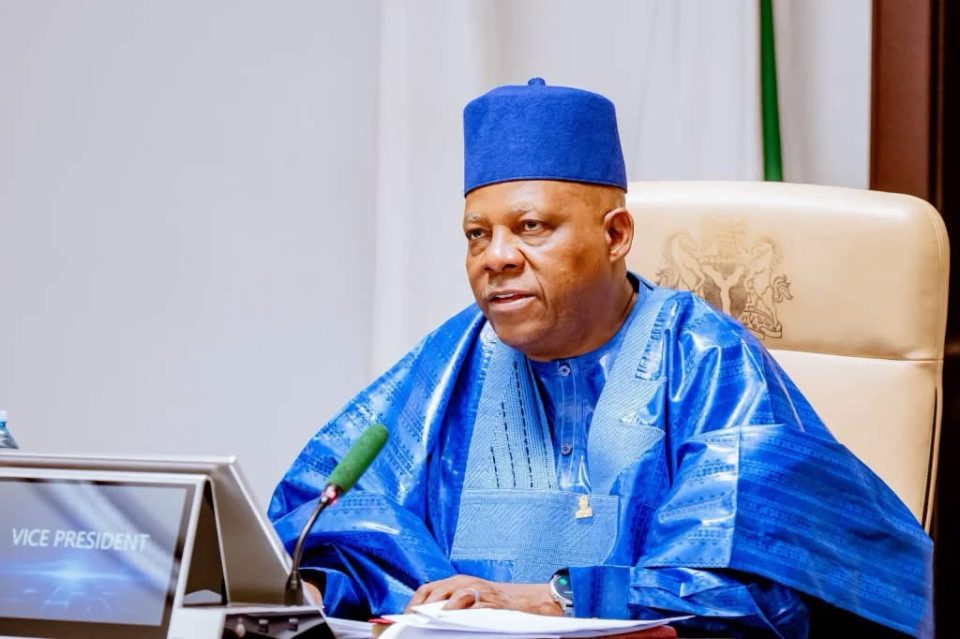
Vice-President Kashim Shettima on Tuesday called on Nigerian leaders to embrace constructive criticism and accountability, warning that a government which listens only to praise risks losing touch with the people it is elected to serve.
Shettima said the country must value the contributions of journalists and intellectuals who challenge those in authority, stressing that their criticisms, however uncomfortable, could help strengthen public institutions and deepen democratic accountability.
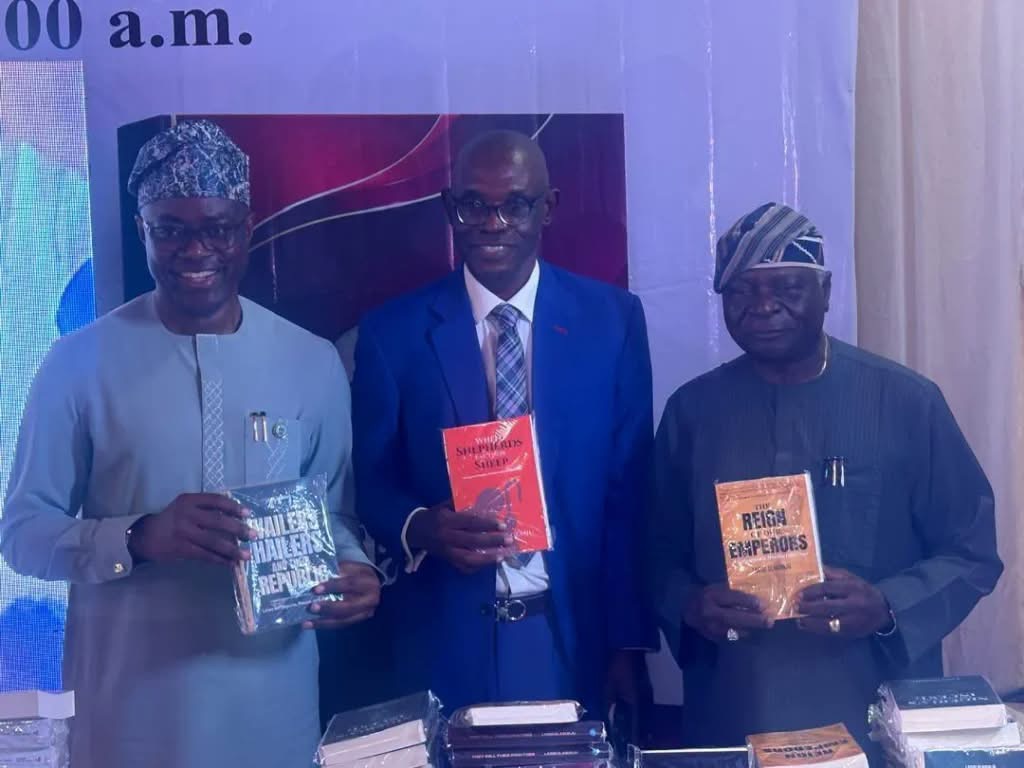
The VP made the call during his goodwill message delivered virtually at the public presentation of nine books drawn from the celebrated Monday Lines column of Saturday Tribune Editor, Lasisi Olagunju, at the International Conference Centre, University of Ibadan, Ibadan, the Oyo State capital.
The event brought together prominent political leaders, academics, journalists and other dignitaries to celebrate Olagunju’s 15 years of political commentary, which has examined Nigeria’s leadership, governance, institutions and national development.
Shettima, who congratulated the author on what he described as a remarkable contribution to Nigerian journalism and letters, said the preservation of the columns in book form would provide future generations with an important record of the country’s political and intellectual history.
He said, “There is a wisdom that says when an elder dies, a library burns. But there is a tragedy we seldom speak about. When a society refuses to listen to its writers, it allows its library to burn while its custodians are still alive.”
He described Olagunju as belonging to a distinguished tradition of journalists who understand that the responsibility of the pen is to awaken the conscience of society.
“His writings remind us that the newspaper is more than a record of yesterday’s events. It is a conversation between a nation and its conscience,” he said.
Shettima said one of the greatest dangers facing public officeholders was the temptation to listen only to opinions that affirmed their positions.
“Human nature draws us towards agreement and reassurance. Yet, the voices that challenge our assumptions may sometimes be the very voices we need most. A government that listens only to praise risks losing touch with the people it was elected to serve,” he said.
The VP maintained that journalists who asked difficult questions could render valuable services to the institutions they scrutinised, adding that disagreement should not be interpreted as disrespect.
He, however, emphasised that journalists also had a responsibility to uphold honesty, fairness and intellectual courage, just as public officials must demonstrate humility, accountability and a willingness to listen.
“There is also something remarkable about the decision to preserve 15 years of newspaper commentary in books. A newspaper may be read in the morning and discarded by evening. But the ideas it carries can outlive the events that inspired them,” he said.
He added that the books had preserved the anxieties, contradictions, hopes and arguments of a generation, expressing the hope that they would continue to provoke thought and encourage honest conversations, adding, “The greatness of a nation lies partly in its willingness to examine itself.”
In his remarks, Oyo State Governor Seyi Makinde called for a socio-political reset of Nigeria, saying the country must return to the vision of its founding fathers, who envisaged a federal system that accommodates the country’s diverse nationalities.
Makinde, who is the presidential candidate of the Allied Peoples Movement, said the reset would ensure that governance worked for everyone, irrespective of ethnic background, gender or religious affiliation, adding that the proposal was aimed at rebuilding Nigeria’s socio-political space around inclusion, transparency and accountability.
The governor, who said he had been promoting the reset agenda across the country, maintained that Nigerians should consider a different course if the existing system was not delivering the desired results.
“We came out and said, Let us reset Nigeria. That is the message I have been carrying all over the country. If Nigeria is working for you, if you are okay with the state of things, then don’t change anything. But if it’s not, then let us take a different course. Let us reset our socio-political space.”
He said the journalist’s work had demonstrated that his Monday Lines column could not have been sustained over the years without him being regarded as a vocal critic of leadership.
Makinde said he identified with Olagunju’s experience as a beneficiary of opportunities provided by Nigeria, recalling that he enjoyed free education in Oyo State between 1980 and 1985 before proceeding to the University of Lagos, where he studied engineering without paying tuition fees.
The governor also recalled that he secured employment in Port Harcourt on the strength of his skills and knowledge, despite having no personal connections in the city, noting that Olagunju similarly secured employment at the Nigerian Tribune through his professional competence.
Earlier, the Chairman of the occasion, Prof. Toyin Falola, described Olagunju as a rare journalist-turned-public intellectual whose weekly column had become an archive of Nigeria’s political and intellectual history.
The Mother of the Day and Chairman of the Board of African Newspapers of Nigeria, PLC, publishers of the Tribune titles, Olatokunbo Awolowo-Dosunmu, described the nine books as an extraordinary harvest of intellectual labour, discipline and dedication.
She congratulated Olagunju on what she called a remarkable literary and journalistic achievement, commending the author for sustaining a column that had grown beyond its original newspaper platform.
Awolowo-Dosunmu said Monday Lines had become a running commentary on the Nigerian condition, capturing the country’s triumphs and disappointments, contradictions and aspirations, as well as the often bewildering turns in its national journey.
In his vote of thanks, Olagunju said the decision to publish nine volumes was informed by the need to preserve 15 years of newspaper commentary and provide a coherent record of his intellectual work.
He explained that the books contained selected and arranged columns from the Monday Lines series, which began in October 2011.
Dignitaries at the event were former Osun State Governors Olagunsoye Oyinlola and Adegboyega Oyetola; former Minister of Education, Prof. Tunde Adeniran; former Ambassador to the Philippines, Yemi Farounbi; Oyo State Deputy Governor, Bayo Lawal; among others.
